Skiply
Turning school payments into a family fintech wallet.
- Role
- Lead Product Designer
- Team
- 3 Product Designers
- Product Owner
- Analyst
- 2 iOS Engineers
- My contribution
- Product strategy
- User research
- Experience design
- Visual design
- Design system
- Brand direction
- Timeline
- 9 months
Skiply started as a marketplace where UAE schools listed services and parents paid for them. Together with Rakbank, we rebuilt it as a family fintech wallet for education, everyday spending and family finances.
- Goal
- Transform Skiply from a school marketplace into a financial product built around families.
- My role
- Led the design across strategy, research, UX/UI, design system and brand.

Audience
The new Skiply had to work for a whole family, not just the person making a payment. Parents needed control over education and family spending, while children needed a much simpler way to access and understand their own money.

Research
With little recent research to inherit, I started with stakeholder interviews, competitor research and the existing product. We looked at modern fintech products, mapped how education payments worked in the UAE and used usability testing throughout the project to validate key decisions.

Rethinking Skiply
The biggest change was moving away from a marketplace built around individual payments. The family wallet became the core of the product and brought school fees, children's money, budgets and cards into one place, with separate roles for parents and children.


Designing around people, not limitations
A lot of the old experience was dictated by technical constraints and legacy banking processes. I worked closely with the team to challenge those constraints whenever they hurt the experience, rather than simply designing around them. In one case, this helped us reduce a 32-screen registration journey to 12.
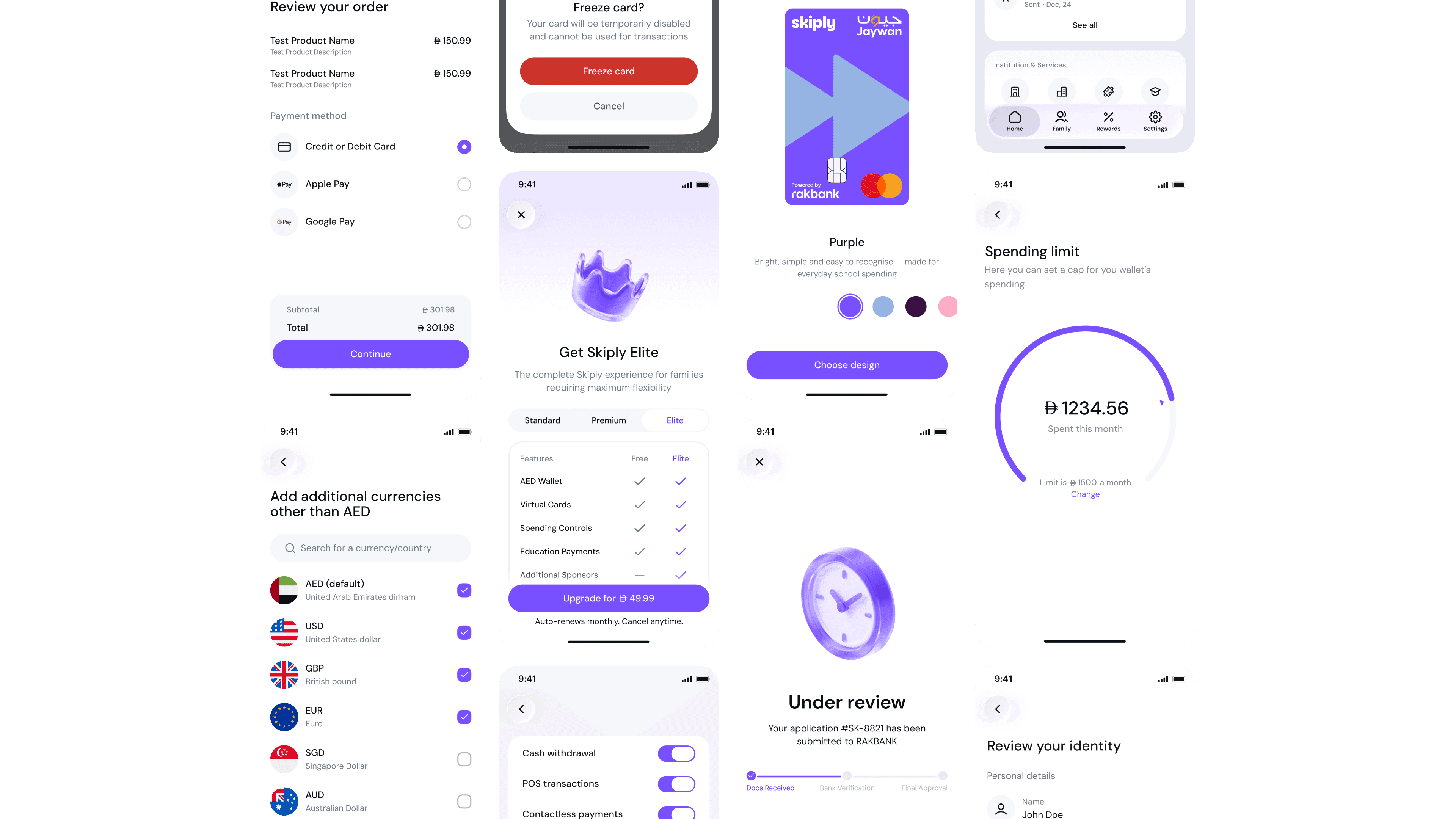
Final design
We rebuilt the core flows and the visual language. The app now opens into the wallet rather than a catalogue of school services. The screens below show what everyday use looks like: the card page, sending money and splitting a payment.


Design system
Skiply needed its own identity while still living inside the Rakbank ecosystem. I built a design system that reused shared foundations where it made sense, while introducing Skiply-specific components, patterns and visual rules that gave the team a clear foundation for future work.

Beyond the app
I also worked on Skiply outside the app: marketing communications, imagery and branded materials. When AI became part of the visual workflow, I documented the tools, prompts and principles so anyone on the team could reproduce the style, not just the designer who invented it.


Outcome
By the end, Skiply had a new product direction, a rebuilt core experience and a design system to build the next features on. The annotated specification and documentation below show how the work was handed over to the team.


Awards
From fall 2025 to summer 2026, our IT transformation program received more than 25 industry awards.

Learnings
My biggest takeaway is that in fintech not every technical limitation deserves to be accepted. Some constraints are real; others are just decisions nobody has revisited. Asking what each one costs the user is how we told them apart. The 32-screen registration was the clearest case.